Welding positioners increase throughput while improving quality, safety

Welding positioners increase throughput while improving quality, safety

Metal fabricators can save labor hours and costs, accelerate production, improve worker endurance and safety, and improve weld quality on large weldments using positioners.


Today every manufacturer is being forced to do more with less. Improving throughput, quality, and safety are challenges that all manufacturers face. As hiring and retaining qualified employees gets tougher and tougher, metal fabricators are looking for better ways to attract competent employees and also to automate their processes.


The larger the weldments and fixtures, the larger the hazards, the greater the frustration with out-of-position orientation, and the more time is wasted. The use of weld positioning equipment is one way that fabricators can make parts faster, better, and more safely than with standard material handling equipment.

How Positioners Work

Generally, positioners can be categorized as single-column or headstock/tailstock. A positioner holds, lifts, and rotates a part or tooling, like a chicken rotisserie. Typically, the weldment is held in a fixture that is bolted securely to the headstock and tailstock or column.
Welder T-Shirt
Positioners control rotation of the part with different types of rotators that allow for 360 degrees of rotation and access to the part. The positioner’s headstocks and tailstocks control elevation and are synchronized to stay level (see Figure 1). Most parts are held in the fixtures as close as possible to the center of gravity. By attaching to the center of the part, a positioner that has 68.5 in. of vertical travel can rotate a part that is over 140 in. wide. This is a useful functionality.


The positioner can lift a part to provide clearance for rotation, rotate the part, and then lower it back down to give the welder access to the work area. All of this can be done in minutes with only one person.
Whether manual, intelligent assisted (semiautomated), or fully programmable, robotically integrated, each type of welding positioner can help metal fabrication manufacturers increase their production rates and improve weld quality while reducing hazards. These improvements are accomplished in a few different ways.

1. How Do Positioners Enhance Safety?

Good Ergonomics, Fewer Hazards. The impact of good ergonomics and fewer hazards that weld positioners can have on your workforce cannot be overstated.
Welder T-Shirt
Cranes, Chains, and Forklifts. The standard material handling methods that rely on chains, cranes, belts, screw systems, fork trucks, and hoists to move, raise, rotate, and position large weldments and their fixtures into position for welding are dangerous and inefficient. Cranes and fork trucks are designed to move material from location to location, not to flip and change the orientation of large parts frequently. Hooking large, heavy weldments and fixtures to chains, forklifts, and cranes poses serious hazards to welders and operators if they fall or swing uncontrolled. This happens when chains slip, straps break, and cranes get damaged.
Additional costs are incurred when damaged cranes have to be repaired because they were used differently than they were designed to be used. Fork trucks aren’t built to play catch with parts as they are rotated. Forks can slip, bend, and break, causing fork truck damage and downtime. Not only can equipment get damaged, employee safety can be jeopardized as well.
Positioners eliminate those hazards because they remove the need for chains, straps, hoists, and cranes to lift and rotate assemblies and weldments. Positioners securely raise and position weldments or assemblies to an optimal height, rotation, and working position (see lead image). 
Figure 1 
A positioner that has 68.5 in. of vertical travel can rotate a 140-in.-wide part 360 degrees.
No More Ladders, Scaffolding. The real safety improvements come from removing the need for welders to use ladders, scaffolding, lifts, and other equipment to climb on a part or lie on the ground to work. Welders and operators feel safer knowing that they are working with equipment that is specifically designed to lift, rotate, and hold their parts securely.
Lower Accident Rate. On average, companies report a significant drop in OSHA-reportable incidents with their use of positioners. As experienced employees leave and new employees come into a company, the “tribal knowledge” of how a part should be rigged and rotated sometimes gets lost, leading to potentially dangerous situations.
Just because employees are really good at rigging and rotating a weldment with chains doesn’t mean that they should be—and there’s no guarantee that they’ll be around tomorrow.
Attracting, Retaining Workforce. There is a lot of movement in the current workforce when it comes to hiring and retaining welders. Ergonomic improvements are an intangible benefit that positioners bring that can boost a company’s ability to attract good welders.
The average age of welders continues to rise across the country, and welders are in short supply. Using positioners can have a direct impact on your welders’ happiness and willingness to work. Instead of having to climb up and down a ladder, weld overhead, or kneel on the ground, a welder can work comfortably and feel better at the end of the day. That alone will help overcome the “This is the way we’ve always done it” mentality that can mount initial resistance to change.
Older, more experienced welders are able to work easier and quicker. This can help to keep them in the workforce longer.
Many companies now have ergonomic departments that look for ways to improve working environments. Positioners allow fabrication companies to protect their employees from injuries and also allow workcells to be easily modified for different employees.
Work Conditions Improvement Case Example. Chesapeake Yachts, located in Chesapeake, Va., installed a weld positioner and backbone fixture in 2017 for welding boat hulls (see Figure 2). The boat hulls can be over 70 feet long and 16 ft. wide, making for a very large piece to build and handle.
The positioner enabled the employees to work longer hours comfortably. The typical workday was extended by two to three hours because the welders weren’t as tired and sore from climbing up and down ladders and using floor creepers to weld under the weldment. As a bonus, the first time Chesapeake Yachts used the positioner on a weldment, it saved 3,000 labor hours.

2. How Do Positioners Increase Throughput?

Less Time Wasted. Not only do positioners keep welders safe while performing welds manually or with integrated assistance, the good news is that they do so without slowing production rates or increasing costs. In fact, positioners increase productivity because they remove wasted time.
Figure 2 
After Chesapeake Yachts installed a weld positioner and backbone fixture for 70-ft.-long , 16-ft.-wide boat hulls, its welders were able to work two to three more hours per day comfortably.
Maximum Arc Time. A lot of arc time is lost when welders have to stand around waiting for cranes or while rigging a fixture to move it. In addition, cranes and rigging require several people to help rotate a large part. It may need to be moved several times before it is in the proper orientation. Using a positioner allows the operator to safely speed up the handling portion of rotating a part and orient that part for the best weld access. This saves labor hours and increases the welder’s arc time.
Labor Savings Case Example. A fabricator had to rotate a large weldment twice to complete the welds. In that facility, two fork trucks plus two spotters were required to lift and flip the part—a total of four employees (see Figure 3). The average handling time was 45 minutes to set up and rotate the piece. Multiplying that time by four employees equals three labor hours. Because the company had to rotate the piece twice, six labor hours for that one part were consumed.
When the fabricator installed a positioner, the same part could be rotated twice in a total of four minutes. They realized a labor savings of five hours and 56 minutes. Plus, because the positioning could be done by only one employee instead of four, the three other employees were free to perform other work.
This reduced, non-value-added labor is the true definition of doing more with less.
Correct Orientation. Production improvements can be gained just by moving the part into the correct orientation. With the weldment positioned properly, a welder can avoid having to weld overhead, vertically, under, or in other awkward positions that hinder productivity. Positioners that allow the welder to access parts in a better and more comfortable position empower him or her to deposit more material at a quicker rate.
These improvements are important because they help experienced welders to work more efficiently. They also help newer, less experienced welders learn their jobs more quickly and easily. By combining improved value-added work with reduced nonproductive, indirect labor, manufacturers can meet their needs to produce more with their existing workforce. New employees become more efficient. More efficient employees result in significant improvement without additional costs—all while being safer.
Robotically integrated positioners allow for even greater improvements in productivity because robots can weld at a much higher travel speed than a human can. A good rule of thumb is that a skilled welder can weld at about 12 to 14 inches per minute using gas metal arc welding. A robot can travel at 20 IPM conservatively. So the robot is welding 50 percent faster and does not require the breaks, vacation time, and sick days that a person needs. Robots also have very high repeatability because the weld program tells the robot what to do and how much weld to deposit. As long as the weld development program is correct, the robot will not miss welds and will put the same welds in place each time.

3. How do Positioners Improve Weld Quality?

Optimal Proximity, Visibility, Arm Position. What about quality? Quality and ergonomics go hand in hand. With positioners helping to put the work in the best possible orientation, the welder can make better welds.
Welding OEMs advise that a joint in the 1F or 2F position allows for better penetration and improved deposition rate. A 1F position is a fillet weld that holds the joint at 45 degrees and allows for the best deposition rate. It is the easiest joint to weld. A 2F position is a flat fillet weld at 90 degrees. Orienting the part in either of these positions will result in better welds. Also, with the part in a better position, it is much easier for a welder to make sure that welds aren’t missed.
Positioners improve weld quality because they position the joint in the same place at a comfortable reach with good visibility. This facilitates consistent, repeatable assembly procedures.
Figure 3 
A large weldment that had to be rotated and flipped twice with two fork trucks plus two spotters, consuming six labor hours, was rotated and flipped twice in a total of four minutes with a positioner
Positioners also simplify weld and assembly tool access because they can rotate the weldment 360 degrees, so clamps and contact points are easier to get to and can be easier to operate. Intelligent positioners can be integrated directly into weld management software that verifies weld quality and weld count, ensuring that all welds are made and recordable.
Fabricators that install their first positioners usually realize the benefits within the first days. Production starts to increase. Welders realize that they can do more while being safer and less fatigued. Company management wonders why it had not gotten positioners sooner.

Versatile Work Truck Fleet Helps Freshour Precision Meet Customer Needs


Versatile Work Truck Fleet Helps Freshour Precision Meet Customer Needs

A work truck needs the right tools to tackle any repair or emergency. For Freshour Precision, Miller welder/generators are key.Work truck technician makes equipment repair


With years of experience as a mechanic, welder and fabricator, Willie Freshour decided seven years ago to strike out and start his own business. Freshour had worked as a heavy equipment mechanic, a welder in traditional manufacturing and a fabricator building off-road race cars. He had the experience and the basic equipment in his home garage to launch Freshour Precision.


“The decision to work for myself was as easy as quitting my job and going to work in my garage at first,” Freshour says.
As the business steadily grew in the first two years, Freshour realized it was time to move to a larger location. He bought a farmstead near Hortonville, Wisconsin, with his wife and began rebuilding the old machine shed as the new home for Freshour Precision.
“Before I even had the building done, all of the sudden I had like five employees, and I didn’t even have a sign out yet.”

Solving problems with metal

The business swelled to 20 employees at one point, but Freshour decided he preferred a smaller operation that allows him to maintain more control over jobs and quality. Now back to four employees in addition to Freshour and his wife Angela, the business focuses on welding, fabrication and repair for farming, construction, industrial and heavy equipment customers.

“It became apparent that farmers and customers with heavy equipment have constant needs, so we set up our shop for them,” Freshour says. “They need their equipment to keep working, and they want it done as fast as possible.”
Freshour enjoys that hustle and the gratitude of customers when he saves them money by reducing their downtime.
“They are losing money by the minute and we stop the bleeding. I really like that part.”
Designed as a one-stop business, Freshour Precision can machine and weld parts in the shop and also make repairs and complete installation on customer jobsites thanks to a fleet of work trucks.
“We can help with projects from start to finish,” Freshour says. “We solve problems with metal.”

Versatile truck fleet

The company’s work truck fleet is constantly changing as older trucks are replaced with newer models. The fleet typically totals seven or so trucks, with most work happening during spring, summer and fall. In the summer, the business can have six or seven trucks running every day for weeks.
Trucks in the fleet range in age from 1986 to 2018 models. Freshour prefers Ford Super Duty trucks because they have heavy-duty chassis and are available in different sizes, and he’s had good luck with maintenance. He buys a lot of class 5 trucks, which provide plenty of cargo room and hauling capacity for welding gear and other accessories.
“Fully loaded, it might weigh 14,000 pounds, but you can still hook up a trailer and throw a big telehandler on it, load a bunch of steel on the roof rack, and still safely drive down the road,” Freshour says.
Outfitting the truck with the right accessories is important. Freshour and his employees frequently reorganize their work trucks to maximize space. Along with having an engine-driven welder/generator on every vehicle, key accessories include mechanic tools, rigging, an air-arc setup, grinding tools and come-alongs. The trucks also carry ladders, personal protective gear and safety equipment for fall protection.
During the busy season, some trucks are built out lighter, and those are typically used on new construction jobsites. Other vehicles in the fleet are more heavily stocked with equipment and tools, and those are designed for repair work.
“When you’re doing emergency repair work, you have to bring everything but the kitchen sink,” Freshour says. “Repair work is very unpredictable.”

Welding is critical

Choosing the right welder/generator is key to completing a wide variety of jobs. Freshour typically wants a welder/generator that can power two welders simultaneously and weld up to 3-inch-thick plates. The company mostly stick welds on customer jobsites but also needs the capabilities and tools to weld with wire when the application calls for it.

“The heart of the whole operation is the welder/generator,” Freshour says. “As soon as you throw one on the back of a flatbed, you have a service truck.”
The Miller® Trailblazer® 325 gas welder/generator is a favorite for Freshour Precision. It offers fuel efficiency and reduced engine noise for a quieter jobsite, and the compact design provides space savings so there’s plenty of room on the truck for other tools and gear.
“If you’re welding with 1/8-inch 7018 electrodes, another guy can plug in with another inverter machine and weld with 1/8-inch electrodes, and the Trailblazer has plenty of power for that,” Freshour says.
The company’s mechanic-only truck also includes a crane body, so that truck has a Bobcat™ 200 Air Pak™ welder/generator on board. The rotary-screw air compressor can power air tools, including most impact wrenches, supplying 28 cfm at 175 psi and 100 percent duty cycle.

Staying on top of fleet maintenance

The slower winter months are a good time for Freshour Precision to thoroughly inspect the work trucks and reorganize them as needed, but it’s also important to stay on top of truck and welder/generator maintenance during the busier seasons.

“In the summer when the trucks run all week and drive a few hundred miles a day, we might spend all weekend maintaining the trucks. Just keeping up with oil changes is hard,” Freshour says. “But you can’t run your truck that many miles and your welder all day and not maintain it, or you’ll run into problems.”

Freshour knows that staying on top of regular maintenance — even during the busiest seasons — is a key part of keeping his busy fleet on the road to serve customers. He also suggests not using work trucks as personal vehicles, which helps limit the wear and tear on them.
Investing in quality equipment and tools — and taking the time for proper maintenance — are keys to success for Freshour Precision.

Quality control for tube, pipe producers

Quality control for tube, pipe producers

Visual, thermal, laser inspection devices monitor processes, help prevent flaws

Quality control for tube, pipe producers - TheFabricator.com

Years ago tube and pipe producers relied mainly on eddy current testing and ultrasonic testing for detecting short- and long-duration weld faults, respectively. These testing systems are still useful and in many cases required, but the spread of electronic technology has provided many more types of testing equipment for use on tube and pipe mills.

If you produce welded tube or pipe for a living, you know that tube and pipe mills need constant monitoring. Many variables are at play, such as the dimensions, hardness, and edge condition of the incoming material; the power delivered to the welding unit; and the condition of the mill as the tooling surfaces, bearings, and other components wear.
ADVERTISEMENT 


How does such a dynamic process result in a usable product? Even if you eliminate many of the potential problems by following a regular maintenance schedule and using standardized setup procedures, it can be a challenge. Forge welding, the process on electric
resistance welding (ERW) mills, has different challenges from those in autogenous welding, the process used on plasma, laser, and tungsten inert gas (TIG) mills, but on both mill types, good or bad tube happens where the welding process takes place.
“Great yield results from two factors only—sound welds and stretch,” said Bud Graham, president of Welded Tube Pros LLC in Doylestown, Ohio. “In the past the shape of the formed pipe section was relatively unimportant. It didn’t have to be round at the weld point. The important points were parallel edges and the smallest possible deviation in edge height,” he said. The two processes, forge welds made with heat and pressure ERW mills and heat alone to make a cast weld structure on other mills—relied on rigid mill stands and shafts to maintain the outer profile and stretching to eliminate camber and edge wave.
“These principles haven’t changed, but these days tube and pipe manufacturers put much more emphasis on forming the product round—they want to eliminate any hint of ovality,” Graham said. “This is driven by the mandate to use the least possible amount of weld power so only the edges of the material are heated for welding. On the surface, this makes sense, but it doesn’t take into account that induction welding isn’t too efficient in the first place.”
ADVERTISEMENT 

Meanwhile, forming the tube or pipe round these days is more challenging as many mills operate with fewer fin and sizing passes. It’s all the more difficult because over the years line speeds have increased and mill staffing levels have decreased, Graham explained. Also, the price of steel is a big factor that has caused some operations to try to produce tube with narrower strip width than previously (see 
Sizing and Stretching sidebar).

“The need to reduce part weight, especially in the automotive sector, is driving the increased use of higher-strength, thinner-gauge material,” said Pierre Huot, founder and CEO of Invisual E. Inc., Toronto. “These materials are more challenging to form and weld than traditional materials,” he said.
The upshot is that you’re playing the hand you were dealt: you are trying to form round tube with fewer forming stands than in the past; the strip might be a little narrower than specified; line speeds have increased; some of the materials are more challenging to form; and staffing levels have fallen. If you’re accustomed to using an eddy current system or ultrasonic monitoring system, which are useful for detecting short-duration and long, continuous changes in the weld, respectively, you probably need more tools.
“It’s not enough to have a single method of monitoring the mill,” Graham said. “You have many more choices today. You can combine eddy current or ultrasonic with something else, such as a flux leakage detector, optical sensors, or laser-based detectors. This gives much better coverage—the whole is greater than the sum of the parts.”
Such equipment has other important benefits.
“Many tube and pipe producers are looking for ways to make their staff more useful and more capable,” Huot said. “They’re looking to automate more tasks, so the operators use less brawn and more brain.”
Quality control for tube, pipe producers - TheFabricator.com
Figure 1: In an optical system, an emitter and a sensor are placed on opposite sides of the material to be monitored. Light from the emitter’s light-emitting diodes (LEDs) strikes the camera; the image is fed to a processor that determines the precise location of the material’s edge. The LEDs fire in series at a scan rate of up to 2,000 inches per second. Two of these setups can be used to measure the width of the incoming skelp, one unit placed at each edge. Image courtesy of Welded Tube Pros LLC.
It’s not just a matter of making a better product or reducing scrap. Many modern inspection devices are also helpful in setting up a mill after a switch to a different product, and even tuning the mill after a coil changeout for the same product, said Cornelius Sawatzky, sales manager for Xiris Automation Inc., Toronto.

Optics and Lasers

Monitoring locations, dimensions, and spatial relationships is usually done by either an optical system or a laser-based system. Optical systems rely on scanning light-emitting diodes (LEDs) to provide the light, a camera to capture it, and a processor to turn the image received by the camera into useful information (see Figure 1 and Figure 2). A laser-based system uses a laser emitter, receiver, and processor to do essentially the same thing. Of the two types, optical systems are a little more forgiving in their use—they don’t require quite as much care in aiming because the light spreads more. The accuracy is respectable, usually ± 0.010 in. Laser systems require more careful aiming and maintenance, but the upside is they are accurate to less than 0.002 in.
Despite such high resolution, it’s not possible to guarantee that the receiver or detector will find every defect. The limit of a system’s ability to detect flaws is determined by a combination of three factors: flaw size, mill speed, and the receiver’s shutter rate (number of images captured per second).
“Scanning LED systems were developed for use in steel mills,” Graham said. “That’s a harsh environment—scanning LED systems can accommodate mist, fog, and particulates if a clean air stream is blown across the emitter. A laser system is less forgiving and requires more care to ensure that the equipment is installed, aimed, and maintained correctly. With proper care, both systems work in steel mills, so they can work in a tube or pipe mill too.”
Sawatzky said that proper setup requires cooperation among the mill operator and the QA/QC staff or a production supervisor to determine the tolerances. After that, mill operators are capable of running the system.

What to Monitor

Optical systems and laser-based systems are used to detect or measure a variety of flaws in the strip of raw material (properly known as a skelp or slit mult) before it is welded and in the tube or pipe after it is welded.
Skelp shape and edge condition can be measured by an optical system in real time. You should keep in mind that the original coil varies in thickness; it’s thicker in the middle than at the edges. Therefore, two mults slit from the same coil can have different thicknesses. Furthermore, the slitting process cold-works the material, changing its hardness; this also can introduce changes in the material’s flatness. Two flatness defects are camber (a convex shape) and edge wave (a gentle ripple), which are the conditions you want to monitor.
The slitting process also results in a shear zone and a break zone that run the length of the slit mult. This isn’t necessarily a defect, but you should be aware that the slitter tooling dulls as it is used, so the edge quality varies from one end of the mult to the other; shear zone shrinks and the break zone grows as the blade dulls. Likewise, burrs are more likely to develop as the slitter tooling wears. Finally, the shear angle should be 90 degrees, but this also varies.
An increase in the amount of edge wave alerts you to take some action, such as adjusting the stretch squeeze pressure or increasing the weld heat. It might also indicate an upstream problem. Perhaps the slitter blades are due for sharpening, whether the product is slit in-house or supplied by a vendor.
The specifics of your mill arrangement—tools, setup, and the number of fin passes—determine the mill’s ability to accommodate excessive camber or edge wave. Knowing this condition exists, and its severity, allows you to make production far more predictable.
Quality control for tube, pipe producers - TheFabricator.com
Figure 4: The arc and weld pool on a plasma mill are easy to see in this photograph, even though the arc is an order of magnitude brighter than the weld pool. Image courtesy of Xiris Automation Inc.
Strip width and edge condition can be monitored by optical or laser equipment. Rolled-over edges or improper edge break results in nonuniform forge conditions.
Edge mismatch warrants quite a bit of attention because edge presentation is the last step before heat and pressure create the forge weld in ERW operations. The visual output provided by a camera and precise measurements of a laser are a powerful combination for monitoring edge mismatch. Xiris and Invisual E use triangulation for an accurate measurement.
“The display shows the surface shape,” Sawatzky said. “It’s not the entire cross section, but just the top portion, so you can see how the right and left edges line up. The system overlays a perfect circle so you have a reference, and it measures the amount of mismatch as well.”
The operator can set limits, but doesn’t have to do any calculations—the limits are set to percentages of wall thickness.
Strip surface speed and the finished product’s exit speed can be monitored by contact encoders or laser Doppler gauges. The difference between the input and output surface speed helps you determine the amount of stretch, one of the key components in a good yield.
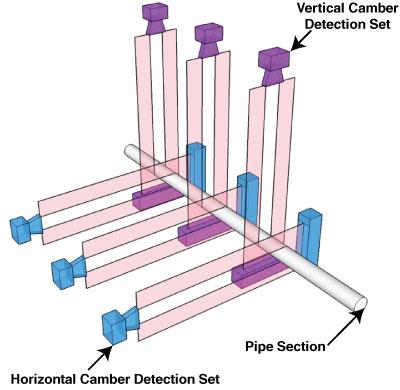
Tube straightness and roundness can be monitored in real time with optical sensors in two planes.

Looking at the Welding Arc, Pool, and Bead

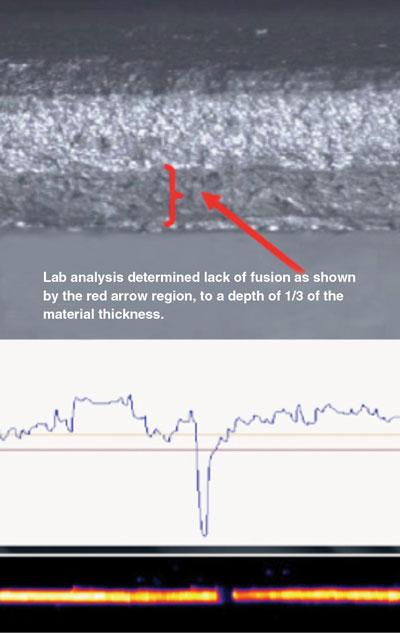
Infrared systems and the associated software are sophisticated enough to monitor the thermal characteristics of the weld in real time. This type of system combines data streams for characteristics such as heat, pressure, and real maximum temperature to help the operator understand what is happening at the weld. The opticalless sensor collects thermal data at 400 Hz, processes the information, and looks for disturbances in the thermal profile (see lead photo and Figure 3).
Some mills have eliminated cold welds by working in tight tolerance envelopes and training the mill staff to adjust the mill and power inputs to the weld monitor procedure, Huot said.
Monitoring the weld area used to be limited to watching the arc only. Welding generates so much light that it overwhelms a regular camera; a dark lens filters much of the light, allowing you to watch the arc but obscuring the weld pool.
High dynamic range (HDR) cameras use sophisticated algorithms to tone down areas where the image is extremely bright so that the resulting image has consistency between the light and dark areas (see Figure 4). In other words, you can watch the size and shape of the arc and see what’s happening in the weld pool.
Quality control for tube, pipe producers - TheFabricator.com
Figure 6: A graphic display that supplements numeric information with color indicators—red, yellow, and green are common—allows quick assessments. Image courtesy of Xiris Automation Inc.
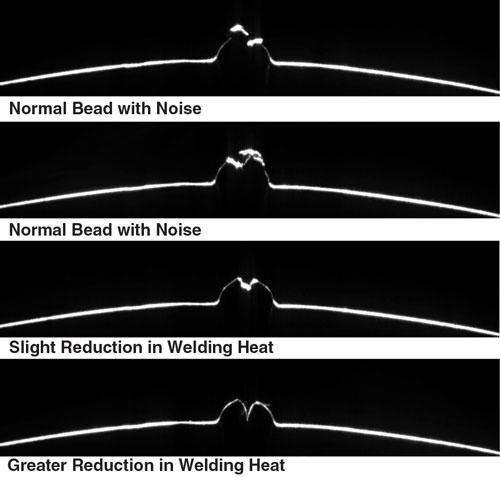
The outcome of the welding arc and the squeeze pressure is the weld bead. Even though the weld bead is a small portion of the parent material, it tells a lot about the welding conditions. A normal forge weld results in a slightly protruding (convex) bead, which usually is removed by the scarfing tool (see Figure 5).
A sunken (concave) bead is a sign of trouble that usually is noticed when the tube or pipe is inspected; likewise, an M-shaped bead comes to the operator’s attention when the scarfing station generates a split scarf. Laser-based monitoring of the bead shape at the weld station alerts the operator immediately that he needs to adjust the squeeze pressure or change the amount of weld current to deal with these problems.

Monitors and Alarms

Mill operators are too busy to stare at a monitor, attempting to decipher a complex display and trying to interpret its meaning, Huot said. Modern displays are intended to make the operator’s job as easy as possible (see Figure 6 and Figure 7).
“The systems generate a huge stream of data and sophisticated algorithms to turn it into meaningful information, but the operators need something immediate, so we rely on visual indicators like sliders to show if the process is good, marginal, or critical,” Huot said.
“A good visual display makes it easy for the operator to understand how the system works,” Sawatzky concurred.
Light towers and audible alarms commonly are used to let you know that some aspect of the process has changed and it needs immediate attention. Today’s systems also can mark the pipe or tube with a bit of paint so it gets extra scrutiny from quality control personnel.
It’s important to remember that these systems don’t pinpoint specific problems; they provide warnings that the process is no longer stable.
“An alarm doesn’t necessarily mean you’re producing bad tube,” Sawatzky said. “It means you should have a look at this.”
Sawatzky added that the data can be stored, thereby providing auditing capability. A look back at stored data can be helpful when investigating a customer complaint about substandard product.
Huot pointed out that mill monitoring equipment isn’t a matter of one-size-fits-all. The system’s settings must be tailored to each mill.
Quality control for tube, pipe producers - TheFabricator.com
Figure 7: Visualization of the process’s health status allows the operator a quick view of current conditions to make decisions in real time. Image courtesy of Invisual E.
“The system is only as good as the people using it, and useful results come only after determining the correct threshold settings,” Huot said. “These systems need to be taught; determining the correct recipe or weld procedure is a learning process that takes time, but eventually the mill staff learns more about the process and quality procedures as a result.”

Standardized Setup Procedures

The last stage in setting up a mill is a destructive test, such as a reverse bend or cone expansion. Before getting to that stage, operators use less definitive test methods. For example, it’s common practice to check for mismatch by running a fingernail over the surface. This tells you that you have mismatch, but doesn’t measure it. In contrast, an electronic system measures the severity of edge mismatch.
“When trying to get the machine dialed in, instead of making some changes and then feeling for mismatch, or feeling for bead shape, this is much quicker,” Sawatzky said. “They look at the screen, make a little adjustment, and they can see the effect on-screen.
After that they take a cross-section sample to verify the setup, and they’re ready to go. It really simplifies the process and eliminates time-consuming trial-and-error adjustments,” he said.

Sizing and Stretching

Welded Tube Pros’ Bud Graham explained how ERW mills process a strip of material to make a good profile for welding. The most misunderstood subprocesses are two related aspects, sizing and stretching.
“A common misperception is that you can save money by decreasing strip width,” he said. “You might get by with a slightly narrower width than specified, but the forge welding process needs a little extra material. The forge welding process squeezes out this material, which otherwise would interfere with a sound weld. A strip that is too narrow reduces the amount of squeeze-out, making a sound weld difficult to achieve.”
Even if the weld is good, undersized strip generally results in smaller-than-desirable tube girth at the exit of the weld point. The tube doesn’t fill the sizing passes, resulting in less sellable footage.
Another critical, and often ignored, point is that the mill stretches the material, Graham explained. The mill’s driven rolls pull the material through the mill, stretching it in the process. This reduces ripples and waves in the incoming strip and straightens the tube after it’s welded. When the strip is the correct size, it fills the sizing passes, enabling the mill to put enough tension on the strip to stretch it. Undersized strip doesn’t do this, increasing the final product’s ovality and decreasing its straightness.
Slightly oversized strip doesn’t cause these problems. It actually increases the yield because the extra material gets pulled through the mill and increases the output. Rather than try to save a few dollars by buying undersized strip, tube and pipe producers should minimize gauge variation. Heavier-than-specified gauge results in heavier-than-specified wall thickness, which is a waste of material.